
(Because I believe in transparency: I’ve been busy with research and PD over the last week. I outsourced this blog post to AI because it succinctly and quickly gathered examples to share here).
As math teachers, we all want our students to be “fluent” with their math facts. The common image of a fluent mathematician is often someone who is “fast” and can instantly recall “7×8=56” This focus on speed, often reinforced by timed tests, has long been the gold standard in math education.
But is this the most effective way to learn? Stanford Professor Jo Boaler and her team at Youcubed challenge this conventional wisdom in their groundbreaking research, “Fluency Without Fear.”
The Problem with Rote Memorization and Speed
The research in “Fluency Without Fear” makes a compelling, evidenced-based case: traditional speed drills can actually inhibit learning. Here’s why:
- Triggers Anxiety: Timed tests and high-stakes recall often create math anxiety, which actively blocks the brain’s working memory. When students are stressed, they can’t learn.
- A “Fixed Mindset”: Speed becomes a proxy for intelligence in the classroom. Students who are naturally slower processors believe they “aren’t math people,” fostering a debilitating fixed mindset.
- Lacks Flexibility: If you only memorize 7×8=56, and you forget it, you’re stuck. If you understand that 7×8 is just 7×7 plus another 7 (or that it’s the same as 14×4), you have flexible, creative strategies that never fail you.
(The examples above and original paper can be found at https://www.youcubed.org/wp-content/uploads/2017/09/Fluency-Without-Fear-1.28.15.pdf )
Boaler and her colleagues argue that true fluency isn’t about speed; it’s about flexibility, accuracy, and efficiency.
Building Fluency Visualized
How can we help students learn facts without the fear? We need resources that emphasize number sense and visual thinking. When students “see” the math, they build stronger neural connections than through rote repetition.
Let’s look at a concrete example of how to make facts visual using Youcubed’s Math Cards.
These aren’t your traditional flashcards. Look at the cards representing the number 12 below:
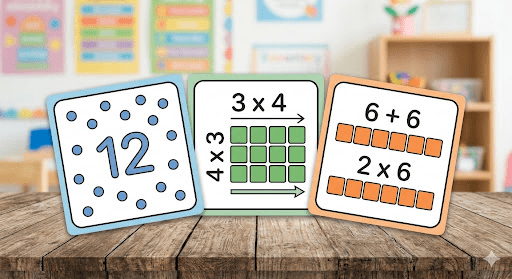
The card on the left shows “12” through scattered dots (encouraging subitizing and grouping). The middle card visualizes 3×4 and 4×3 as a concrete area model—a green 3×4 grid. The card on the right shows 12 decomposing into 6+6 and 2×6 using vibrant orange bars (similar to Cuisenaire rods).
Putting It into Practice: Classroom Resources
If you’re ready to bring “Fluency Without Fear” into your classroom, here are four actionable, research-backed resources to get you started:
1. Number Talks (A Daily Must-Do)
This is a high-impact, low-prep 10-minute daily routine popularized by Ruth Parker and Sherry Parrish.
- How it works: Present a computational problem mentally (e.g., 18×5). Students use thumbs to their chests to signal they have an answer and at least one strategy. The magic happens when they share how they saw the problem. One student might see 10×5 and 8×5, while another sees (20×5)-(2×5). This celebrates mathematical flexibility.
- Visual Strategy: For younger grades, start with Dot Images. Show a card with dots arranged randomly and ask, “How many do you see? How do you see them grouped?”
2. Visual Models and Manipulatives
Research confirms that the brain processes math along two pathways: one symbolic and one visual. We must bridge these in the classroom.
- Area Models: Instead of drilling tables, have students use graph paper to build “fact family grids.” They can color a 8×7 rectangle and physically see it is made of fifty-six small squares.
- Cuisenaire Rods: These proportional rods are excellent for seeing the relationship between numbers as physical lengths, making the composition and decomposition of numbers intuitive.
3. Low-Floor, High-Ceiling Tasks
To reduce anxiety, replace closed, single-answer questions with open-ended explorations where every student can find a path.
- Which One Doesn’t Belong? (WODB): Visit wodb.ca. Show students a box with four items (four numbers, four shapes). Ask, “Which one doesn’t belong?” The trick is that there is a valid, justifiable mathematical reason for any of the four choices. This shifts the focus from “getting the right answer fast” to “making a mathematical argument.”
- Estimation 180: Use Andrew Stadel’s wonderful resource to practice daily estimation. Asking “What’s an answer that’s too low? What’s too high? What’s your brave guess?” celebrates mathematical reasoning over instant recall.
4. The Week of Inspirational Math (WIM) on Youcubed.org
Youcubed provides several weeks of entirely free, detailed lesson plans designed by Jo Boaler and her team. These lessons focus heavily on open-ended visual tasks and are designed to cultivate a growth mindset right at the start of the school year. They are the perfect ready-to-use resource for implementing Fluency Without Fear.
The Shift
The transition from a classroom focused on speed and drills to one focused on flexibility and visual sense doesn’t happen overnight, but the results—in both student confidence and algebraic readiness—are transformative.
Let’s empower our students to see that math is a creative, visual subject where everyone has the capacity to be fluent, without the fear.

 The Blended Bulletin
Leave a comment